A kitchen fire is not a regular fire. It is a very specific combustion problem with very specific rules, and most residential fire safety tools were not built to handle it. Understanding why is the key to understanding why a purpose-built solution like FireBot performs the way it does.
To get there, it helps to start with what a kitchen fire actually is at a chemical level, then look at why conventional tools struggle, and finally examine the engineering that makes a real difference.
Why a kitchen fire is not like other fires
A fire, at its core, is a self-sustaining chemical reaction that needs four things: fuel, heat, oxygen, and an uninhibited chemical chain reaction. Fire professionals call this the fire tetrahedron. Remove any one of those four elements and the fire stops. Different kinds of fires require different removal strategies, which is why there are five recognized fire classes (A, B, C, D, and K) rather than one.
Cooking oil sits in its own class, Class K, for good reason. Common cooking oils auto-ignite at shockingly specific temperatures. Research on the auto-ignition of cooking oils has found that canola oil auto-ignites at roughly 424°C (795°F), vegetable oil at 406°C (763°F), and olive oil at about 435°C (815°F). Once an oil passes these thresholds, it will ignite on its own with no external flame or spark. No match, no pilot light, just heat.
That is why a grease fire can grow from a flicker to a full pan fire in seconds. And it is why the worst thing a person can do is throw water on it. When water hits burning oil, it sinks beneath the oil (water is denser), flash-vaporizes, and expands to roughly 1,700 times its original volume. That expansion atomizes the burning oil into a cloud of flaming droplets. A small pan fire becomes a room-sized fireball.
None of this is hypothetical. It is the physics every kitchen fire operates under, whether the person cooking knows it or not.
Why conventional tools struggle here
Most residential fire safety equipment was designed for a more general problem, not this specific one. That mismatch is where things break down.
Smoke alarms are critical for general fire safety, but they are a poor fit directly above a cooking surface. Cooking produces smoke by design. A seared steak, a piece of burnt toast, steam from a boiling pot — none of these are fires, and smoke alarms cannot reliably tell them apart from one. Nuisance alarms are one of the top reasons people disable their smoke detectors, and a disabled detector cannot do its job. Newer smoke alarm standards have made real progress on this, but the fundamental problem remains: smoke is not a reliable signal for an active kitchen fire.
Dry-chemical extinguishers, the ABC-rated red canisters in most kitchens, have their own weaknesses. The powder can put out a small grease fire, but it does not cool the oil. If the oil is still above its auto-ignition temperature when the powder disperses, the fire can reignite. It is a documented enough problem that, in 1994, Underwriters Laboratories introduced UL 300, a stricter standard for commercial kitchen suppression systems, specifically because dry chemical agents were no longer adequate for higher-temperature vegetable-oil fires.
The problem is easier to show than to describe. In this side-by-side test, a grease fire is ignited under identical conditions, and one is addressed by a powder canister while the other is addressed by FireBot:
Neither of the conventional tools is useless. Both have a place. But for the specific problem of a stovetop fire, neither is enough on its own. This is the gap FireBot is engineered to fill.
How FireBot detects a fire (without false alarms)
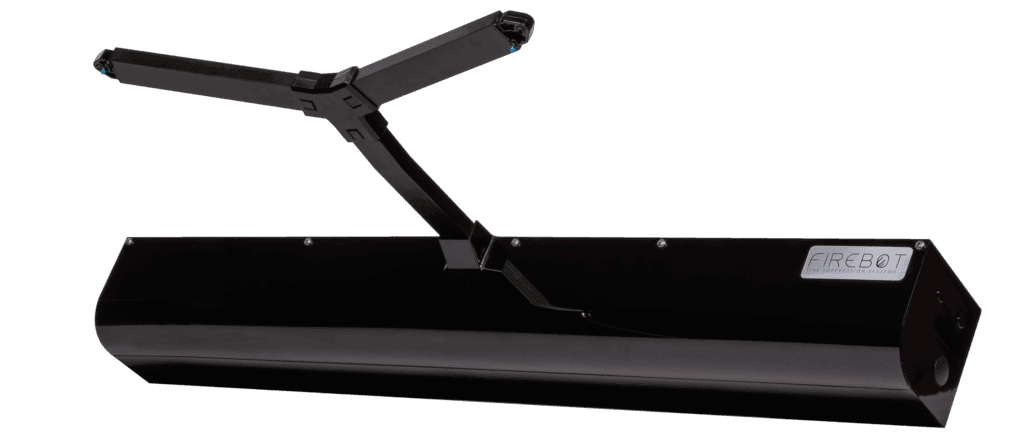
FireBot does not use smoke. It uses heat, specifically, the pattern of heat over time.
Inside the device are two precision thermal sensors that continuously monitor the temperature profile of the cooktop below. The key word is profile. A simple fixed-temperature sensor would trip whenever the cooktop got hot enough, which would mean false alarms every time someone seared a steak. A simple rate-of-rise sensor would trip whenever the temperature climbed quickly, which would mean false alarms every time someone preheated an empty pan. FireBot’s sensors are engineered to analyze both signals together (the absolute temperature, the rate of change, and the duration) in order to distinguish the normal thermal signature of cooking from the rapid, sustained temperature spike of an out-of-control fire.
When the sensors detect temperatures crossing into the danger zone, FireBot follows a deliberate three-stage response. It begins with a repeating beep, the high-heat warning, which signals that the cooktop is approaching a critical threshold. If temperatures continue to rise, the beep becomes a solid, continuous alert, signaling that suppression is imminent. And if the fire is confirmed as out of control, the device activates automatically and discharges its suppressant over the cooking surface. The alarm is not an opt-out window; it is a safety communication. It ensures that anyone nearby knows something is happening before suppression begins.
This is what it means to build a detection system for a kitchen specifically, rather than adapting a general-purpose smoke detector and hoping it works.
How FireBot puts the fire out (and keeps it out)
The other half of FireBot’s engineering is what actually comes out of it when a fire is confirmed. This is where most stovetop suppression conversations get oversimplified, so it is worth going deeper.
FireBot discharges one litre of proprietary Class K liquid suppressant directly onto the cooking surface. Class K agents are a completely different category from the powders in conventional extinguishers. They are wet chemicals, and they work through a chemical reaction called saponification.
Saponification is the process where an alkaline agent reacts with hot oil or fat to form a soap-like foam. It is the same basic chemistry behind how soap is made, adapted into a fire suppression mechanism. When FireBot’s liquid agent contacts the hot oil, three things happen at once:
- It smothers the flame. The liquid floods the fire zone and separates the burning oil from oxygen. Without oxygen, combustion stops almost immediately.
- It cools the pan below auto-ignition temperature. This is something dry powder simply cannot do. Water content in the liquid absorbs heat as it vaporizes, pulling the oil’s temperature back below the 400 to 435°C threshold where auto-ignition happens. The fuel is no longer hot enough to reignite.
- It forms a surfactant seal over the grease. The saponification reaction creates a soapy foam layer that sits on top of the oil and physically blocks oxygen from reaching it. Even after the initial suppression is over, this seal prevents reflash, one of the most dangerous characteristics of grease fires.
This triple mechanism is why wet-chemical Class K agents became the standard for commercial kitchen suppression under UL 300, and why dry-chemical extinguishers were phased out of commercial food-service applications. FireBot applies the same proven chemistry to the residential kitchen.
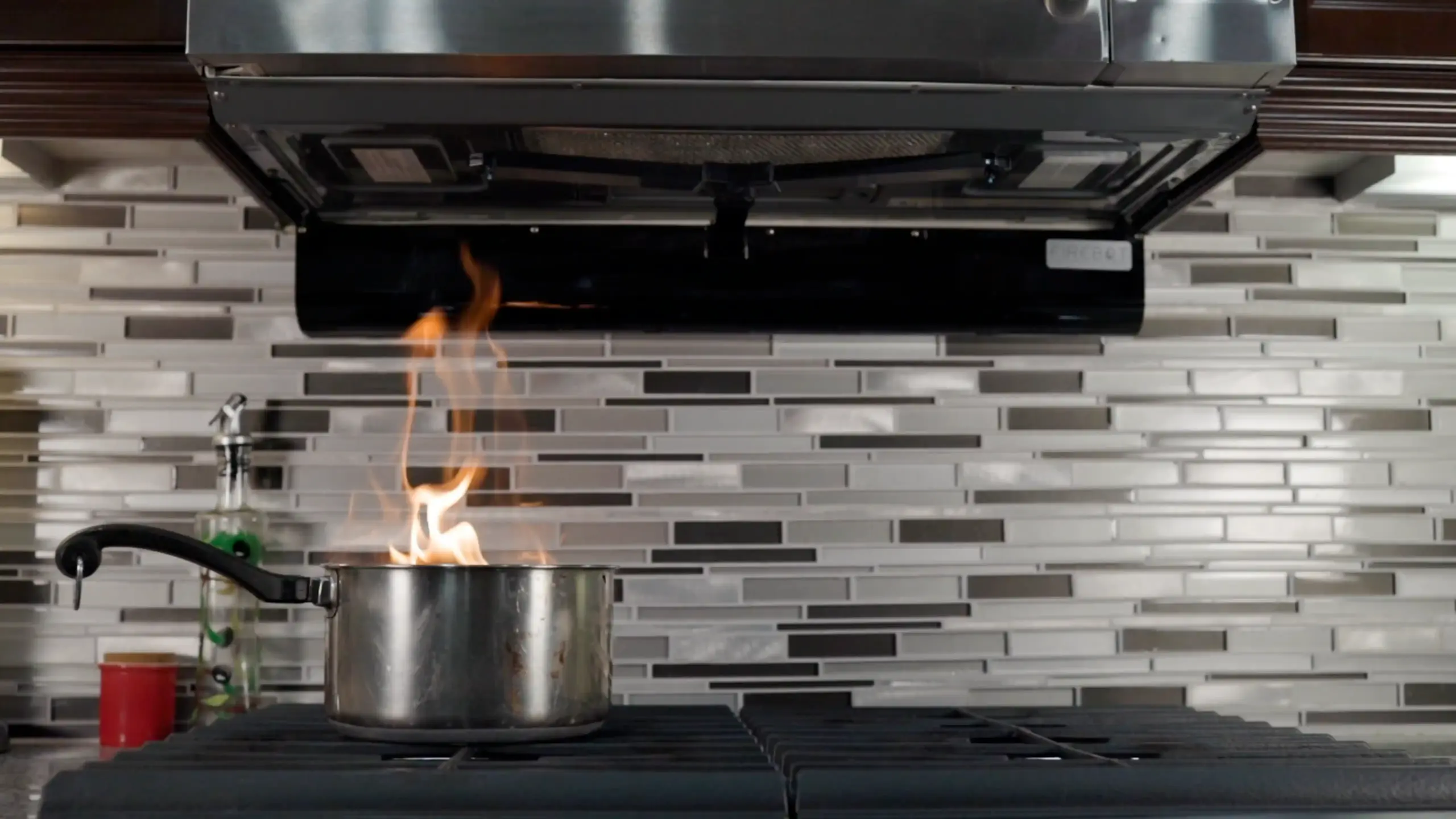
And it has been independently validated. FireBot was tested at a third-party fire safety laboratory to UL 300A, the benchmark standard for residential cooktop fire suppression. UL 300A tests for suppression effectiveness, anti-splash performance (so burning oil is not ejected during discharge), and critically, anti-reignition, ensuring the fire stays out after the suppressant has done its work. Here is what one of those tests looks like in practice:
You can read more about what the standard covers on our UL 300A overview page.
Why this engineering matters
The engineering is not academic. Cooking fires are the number one cause of residential fires in the United States, year after year. According to the U.S. Fire Administration, residential building cooking fires accounted for 167,800 incidents, 125 deaths, 2,500 injuries, and more than $572 million in property loss in 2023 alone. The National Fire Protection Association notes that cooking causes roughly 72 percent of all fires in apartment buildings, a disproportionate risk for multifamily housing.
And the losses are substantial. State Farm reported that between January 2024 and November 2025, the insurer paid nearly $234 million in cooking fire claims, with the average cooking fire loss exceeding $73,000. A single residential fire claim raises a homeowner’s insurance premium by roughly 27 percent on average.
These numbers exist because most of the tools in most kitchens were never designed for the specific chemistry of a cooking oil fire. FireBot was.
Two things, working together
Detection that distinguishes a fire from dinner. Suppression that stops the fire, cools the fuel, and prevents it from coming back, within seconds, with no one in the room. This is the engineering behind FireBot, and it is the reason the device performs the way it does in every independent test and every real-world activation.
There is a lot more on the device itself, including installation, certifications, and the full product specifications, on our How FireBot Works page. Or, if you would like to talk about deploying FireBot across a property, a portfolio, or a partner network, our team is here.